
Last updated October 30, 2026
 Wrought iron
 Wood & steel frame
 Farm & ranch
 Sliding driveway gates
 LiftMaster operators
Free on-site gate assessment - hinges, posts, and your LiftMaster or Nice gate operator checked before anything is quoted
The assessment is free and the quote is the invoice.
Get your free estimateGate Repair Emergency Preparedness Guide for Chino Homes
During a power outage, every automatic gate on your property defaults to whatever state its manual release was last set to – and if you’ve never tested yours, you don’t actually know if you can get your car out. This is not a theoretical concern in Chino, where Santa Ana winds have repeatedly triggered Public Safety Power Shutoffs and evacuation warnings in the hillside neighborhoods north of the 60 and east of the 71. In our experience, roughly seven out of ten Chino homeowners we meet during emergency calls have never touched the manual release on their gate operator. This guide changes that. You’ll learn how to locate and test your release mechanism, understand battery backup limitations, build a pre-failure file, and know exactly what to do when the gate fails at the worst possible moment.
Styles & brands we work with
Quick Answer
A gate emergency in Chino means knowing three things before anything fails: how to manually release your specific operator, whether your battery backup actually works under load, and what information to have ready when you call for Gate Repair services. Most stuck gates are caused by power loss, dead batteries, or a failed limit switch – and most homeowners could have restored access in under five minutes if they had tested their manual release once in the past year. This guide walks you through the preparation that makes a gate failure an inconvenience rather than a crisis.
Table of Contents
- How to Locate and Test Your Gate’s Manual Release
- Battery Backup Systems: What Actually Works During a Chino Power Shutoff
- What to Do When Your Gate Is Stuck Closed
- The Emergency Repair Priority Sequence: Security vs. Access
- Building a Pre-Failure File Before You Need Emergency Service
- Chino-Specific Gate Failure Patterns We See Most Often
- Common Mistakes to Avoid
- When to Call a Professional
- Frequently Asked Questions
- The Bottom Line
How to Locate and Test Your Gate’s Manual Release
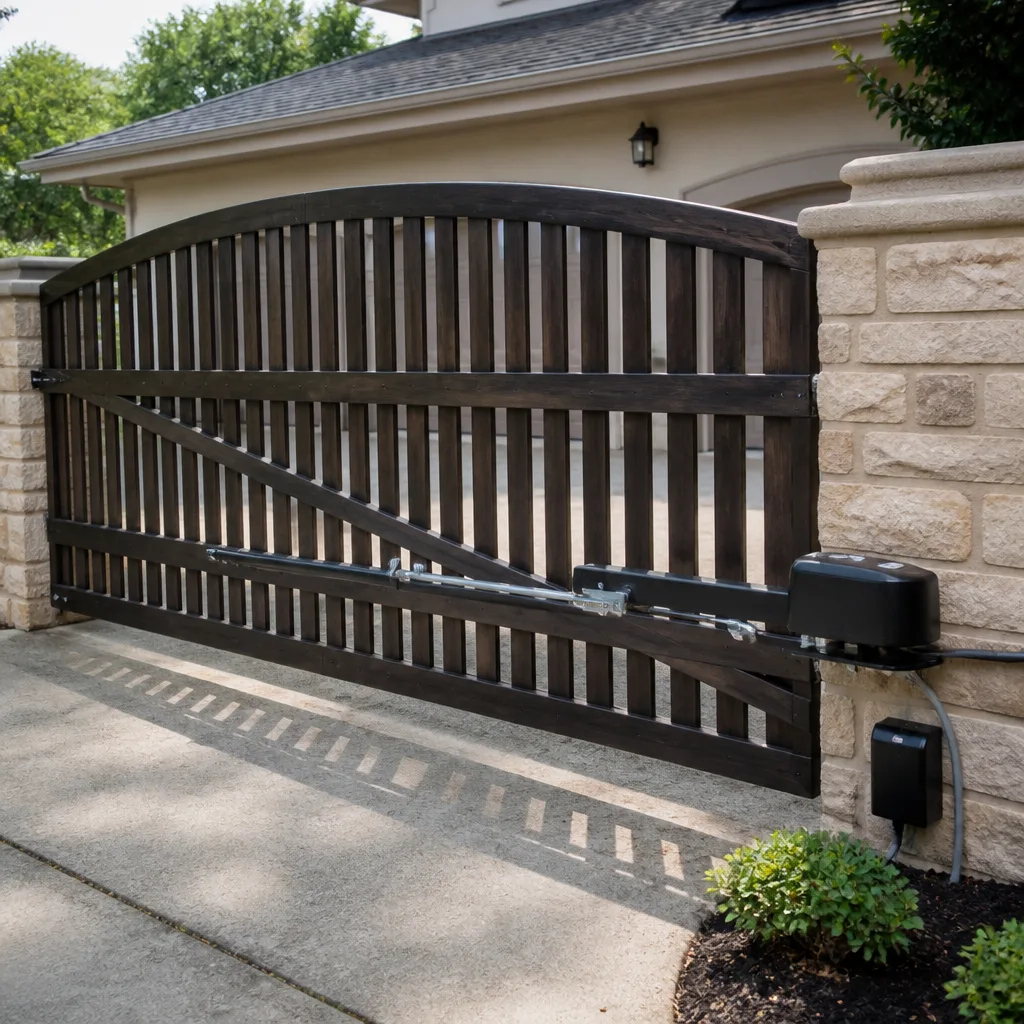
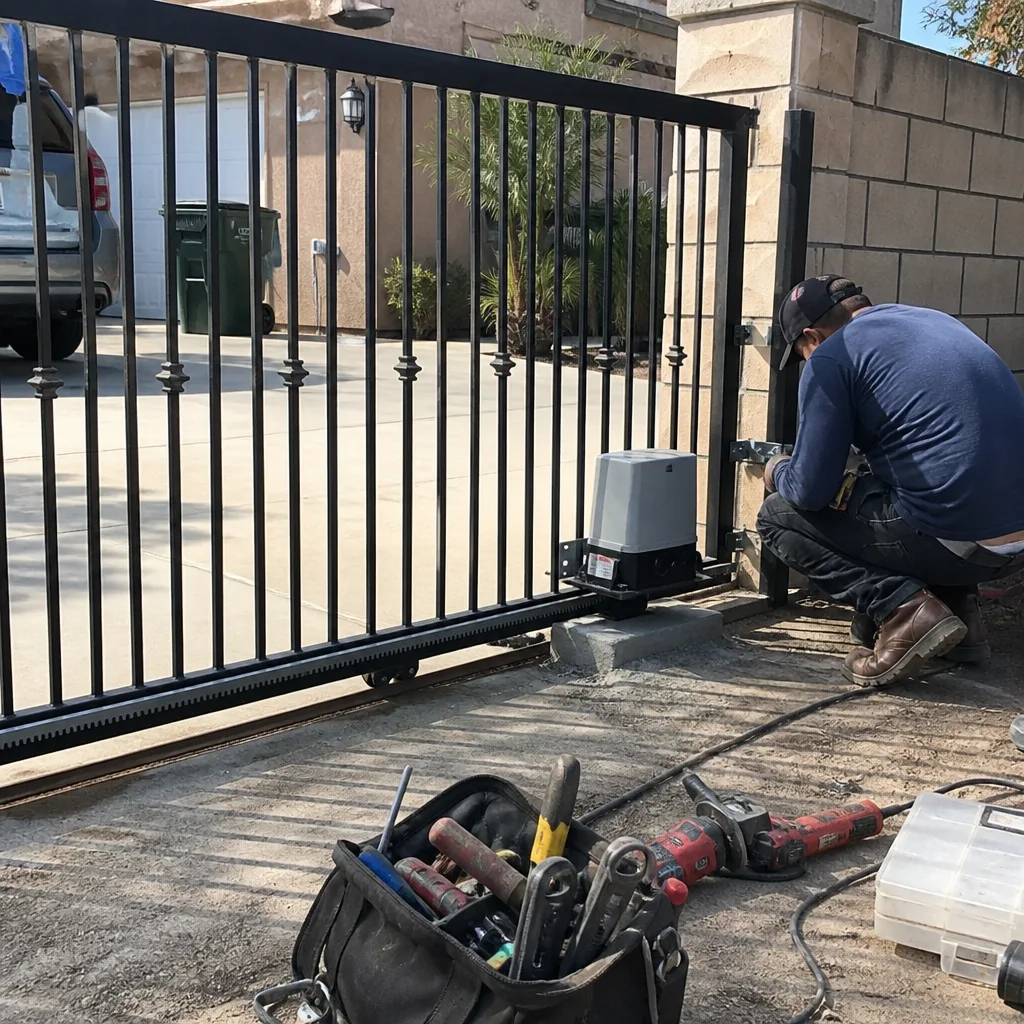
Every automatic gate operator has a manual release mechanism that disconnects the gate from the motor, allowing you to push or pull the gate by hand. The mechanism varies by brand, but the principle is consistent. On most LiftMaster slide gate operators, the release is a red T-handle or lever on the side of the operator housing. On swing gate arms from FAAC and Elite, you’ll typically find a keyed release cylinder on the arm itself. Mighty Mule residential swing operators almost always include a simple pull-pin release at the point where the arm connects to the gate bracket.
Here’s the sequence we recommend every Chino homeowner follow:
- Locate the operator unit. For slide gates, it’s the box mounted on the fence line near the gate’s closed position. For swing gates, it’s the arm attached to the gate leaf itself.
- Identify the release mechanism. Look for a red handle, a keyhole, or a pull ring. If you have the original manual, the release is typically illustrated in the first five pages. If you don’t have the manual, the manufacturer name and model number are printed on the operator unit itself.
- Disengage the release. Turn the key, pull the T-handle, or remove the pin. The gate should now move freely by hand. Do this with the gate in the closed position, not mid-travel.
- Test the full travel. Push the gate all the way open and all the way closed by hand. Note whether it binds anywhere along the track or arc.
- Re-engage the release. Return the mechanism to its normal position. The operator should reconnect on its next cycle. If it doesn’t, you have a release mechanism that needs service – which is a repair we handle regularly.
Plan to run this test twice a year. In Chino, the best times are early spring before the heat arrives and late fall before Santa Ana wind season. Heat causes metal components to expand, which can make a marginally functional release mechanism seize. Cold, while rare here, can stiffen lubricants. Getting in the habit of seasonal testing means you’ll discover problems during a routine check rather than during an evacuation warning.
Battery Backup Systems: What Actually Works During a Chino Power Shutoff
Battery backup on a gate operator is not standard equipment. It’s an optional add-on on most residential installations, and we see it skipped more often than included on homes throughout Chino, Chino Hills, and the surrounding area. The key distinction to understand: a battery backup powers the operator’s electronics and motor, allowing the gate to cycle a limited number of times during an outage. It does not mean your gate functions normally for days.
Real-world runtime depends on the operator type and the weight of your gate:
- Lightweight residential swing gate (single leaf, under 300 pounds): Expect 20-40 open-and-close cycles on a healthy battery, depending on the operator brand.
- Heavy residential slide gate (400-800 pounds): Expect 10-25 cycles before the battery depletes. Slide gates consume more power because they fight inertia across a longer travel path.
- Commercial or oversized residential gates: 5-15 cycles is realistic. The battery is designed to bridge short outages, not serve as a primary power source for days.
Here’s what surprises most people: the battery in your operator is probably dead, and you wouldn’t know it until the power goes out. Lead-acid and AGM batteries typically last 2-4 years in Chino’s heat, and heat degrades battery chemistry faster than cold. If your battery backup is older than three years and has never been tested under load – meaning actually cycling the gate with the AC power disconnected – you should treat it as non-functional until proven otherwise.
Testing a battery backup correctly requires disconnecting AC power and cycling the gate. If you’re not comfortable working with electrical components, skip the test and have a professional verify it during routine service. For homeowners who want to test independently: locate the battery enclosure, unplug or switch off the AC supply to the operator, and cycle the gate using your remote or keypad. If it opens and closes reliably, the battery is holding a charge. If it stalls or fails to move, you need a replacement battery before the next outage.
A note on solar-powered operators, which are popular on Chino properties with long driveways where running conduit is cost-prohibitive: solar systems depend on their battery bank as the primary power source. These systems have different failure characteristics than AC-powered operators with backup. If your solar gate operator has been sluggish in the early morning or after cloudy days, the battery bank is nearing the end of its life. That’s a repair conversation worth having before you’re stuck outside your own driveway.
What to Do When Your Gate Is Stuck Closed
You come home, hit the remote, and nothing happens. Or worse – you need to leave for work, hit the remote, and the gate doesn’t move. Here’s the sequence to follow when the gate is stuck closed and you need access immediately:
- Check the obvious. Is there a vehicle, trash bin, or overgrown shrub blocking the photo eye sensors? In Chino, we see sensor blockages from landscape growth more than any other cause, especially after spring growth spurts.
- Try the keypad or wall button. If the remote doesn’t work but the keypad does, the issue is a dead remote battery or a lost programming code – not the operator. Change the remote battery first.
- Check for power. Is the operator unit’s LED display or indicator light on? If the unit is dark, check your breaker panel. Gate operators are often on their own circuit, and a tripped breaker is a five-minute fix.
- Use the manual release. If the operator has power but won’t respond, or if there’s no power at all, disengage the manual release and open the gate by hand. This is where your seasonal testing pays off – you’ll know exactly where the release is and how it works.
- If the manual release fails or the gate won’t move by hand. The gate is either bound on its track or hinges, or the release mechanism itself has failed. At this point you need emergency gate repair. Getting through a stuck gate by force – ramming it, lifting it, or wedging it open – causes damage that turns a $200 repair into a $2,000 replacement.
One scenario specific to Chino: the hillside neighborhoods off Pipeline Avenue and along Eucalyptus Avenue have many properties with long, steep driveways where the gate is the only vehicle access point. If your gate is stuck closed and your car is behind it, there’s no back lane and no alternate route. This is precisely why testing your manual release matters. It’s your only physical fail-safe when the operator quits.
The Emergency Repair Priority Sequence: Security vs. Access
When a gate fails partially – it opens but won’t close, or closes but won’t lock, or the intercom works but the operator doesn’t – you have to make a decision about priorities. Here’s the sequence we recommend, based on what actually keeps a Chino property secure and functional:
Priority 1: Restore controlled access. If the gate opens manually or partially but you can’t control it remotely, the immediate concern is whether you can get in and out. A gate stuck open is not an access emergency, but it is a security problem. A gate stuck closed with no manual release is an access emergency. Fix access first, because you can’t secure a property you can’t enter or leave.
Priority 2: Restore the locking mechanism. On slide gates and many swing gates, the operator itself acts as the lock. When the gate is disengaged manually, it’s unlocked – anyone can push it open. If you’re leaving the gate in manual mode while waiting for repair, add a physical lock if the gate has a lock bar or chain point. A gate that automatically closes but doesn’t lock is an invitation.
Priority 3: Restore safety features. Photo eyes, edge sensors, and obstruction detection are not optional conveniences. They prevent the gate from closing on a person, pet, or vehicle. If your gate is partially functional but the safety features are bypassed or malfunctioning, treat that as an urgent repair. A gate that closes on a child because the photo eye was disconnected is a liability no homeowner wants to face.
Priority 4: Restore conveniences. Keypad codes, remote programming, intercom integration, and access control features come last. They matter, but they don’t affect your ability to safely use the gate while waiting for a full repair.
Building a Pre-Failure File Before You Need Emergency Service
The difference between a 30-minute emergency repair call and a two-hour diagnostic marathon comes down to information, as explained in our Gate Repair Maintenance Checklist for Chino Homeowners. When you call a gate repair company, having these details ready means the technician arrives with the likely parts on the truck instead of ordering and returning later. Here’s what to assemble now, while the gate is working:
- Operator brand and model number. Look for a sticker or plate on the operator unit. “LiftMaster LA400″ or “FAAC 844″ tells a technician exactly what they’re working with. “Automatic gate thing” does not.
- Gate type and approximate dimensions. Slide or swing? Single or double leaf? Weight matters, so know the height, length, and material – steel, iron, wood, composite. Material determines weight, and weight determines the correct replacement operator and hardware.
- Photos of the full installation. Take four photos today: the gate in the closed position, the operator unit close up, the hinge or track area, and the keypad or intercom. Store them on your phone. When you email or text them to a repair company, you’ve just saved a site visit.
- The gate’s history. Install year (roughly), last service date if any, and any recurring problems – “slow to open when cold,” “grinds on close,” “keypad works intermittently.” These details help a technician narrow the diagnosis before arriving.
- Where the breaker is. Find the breaker that serves the gate operator and label it. Labeling takes thirty seconds and saves you from fumbling through the panel in the dark during an outage.
This file lives on your phone and takes ten minutes to assemble. In our experience, Chino homeowners who have this information ready when they call for Gate Repair in Chino get faster service because we can arrive with the correct diagnostic tools and likely replacement parts on the first visit.
Chino-Specific Gate Failure Patterns We See Most Often
Chino has particular environmental and usage conditions that affect automatic gates differently than coastal or high-desert communities. These are the failure patterns we see regularly across the city:
Heat-related limit switch failure. Chino summers routinely push past 100 degrees, and limit switches – the components that tell the operator where the gate stops – are susceptible to thermal expansion and contact degradation. A gate that overshoots its stop point in hot weather or refuses to close fully is showing early limit switch failure. This is a repair we perform frequently for Chino homeowners.
Dust and debris in the track. The Santa Ana winds carry fine dust and sand that accumulates in slide gate tracks. When enough grit builds up, the gate binds, the motor strains, and the overload sensor trips – which presents as a gate that stops mid-travel. Regular track cleaning is the cheapest preventive measure any Chino homeowner can perform.
Sensor misalignment from wind movement. Long swing gate leaves act as wind sails during Santa Ana events. Gate flex during high winds can knock photo eye sensors out of alignment, causing the gate to refuse to close because it “sees” an obstruction that isn’t there. If your gate reverses immediately after closing during or after a wind event, check the sensor alignment first.
Battery degradation from temperature swings. While Chino doesn’t get extreme cold, the summer-to-winter temperature range is enough to shorten backup battery life. In our experience, backup batteries in Chino outdoor installations fail closer to the two-year mark than the four-year manufacturer rating, simply because of sustained heat exposure.
Power surge damage. Chino’s older residential areas near Central Avenue and the airport corridor experience voltage fluctuations during heat waves when grid demand spikes. Gate operators without surge protection can lose control boards to these spikes. If your gate suddenly becomes unresponsive after a brownout or lightning storm, a fried control board is the likely culprit.
Common Mistakes to Avoid
- Forcing a stuck gate open or closed. Applying vehicle force or leverage to a gate that won’t move converts a mechanical failure into structural damage. Bent tracks, twisted frames, and broken welds are expensive to repair, and the original problem still needs fixing afterward.
- Ignoring early warning signs. Slow operation, unusual grinding, intermittent failures, or a gate that “sometimes won’t close” are not acceptable quirks. These are symptoms of a component nearing failure. Addressing them during regular service costs a fraction of an emergency repair.
- Replacing batteries without testing the system. A new battery in an operator with a failing charging circuit won’t solve anything. If you replace a backup battery and the problem persists, the issue is upstream. Test the system, not just the component.
- Skipping the photo eye check. When a gate won’t close, the photo eye sensors are the first thing to check. Chino’s dust, wind, and landscape growth make sensor issues the most common cause of “gate won’t close” complaints we see. Two minutes of checking and cleaning beats an unnecessary service call.
- Disabling safety features permanently. Some homeowners, frustrated by intermittent sensor problems, bypass the photo eyes to “fix” the gate. This is the most dangerous shortcut you can take with an automatic gate. The sensors exist to prevent injury. If they’re malfunctioning, repair them – don’t defeat them.
- Using a generic handyman for operator-specific problems. Gate operators from different manufacturers have different error codes, different programming sequences, and different parts. A generalist guessing at a FAAC hydraulic operator the same way they’d approach a Mighty Mule chain-drive unit is likely to misdiagnose. Brand-specific expertise matters.
- Waiting until the gate fails to look for the manual. When your gate is dead and you’re locked out, crawling around in the dark looking for an owner’s manual is not the moment to learn how your release mechanism works. Test it now.
When to Call a Professional
Some gate problems are DIY-appropriate: changing a remote battery, cleaning photo eye lenses, clearing obvious debris from a slide track. Others require a technician who works on gates every day. Call for professional emergency gate repair when: the manual release mechanism fails or won’t re-engage, the operator makes grinding or popping sounds, the gate is off its track or visibly misaligned, the control board shows error codes you can’t interpret, or the gate has struck a vehicle or person. These situations involve forces and electrical components that can cause serious injury if mishandled. Lexington Gate Repair offers free estimates in Chino – call (866) 304-1321 for emergency gate repair.
Frequently Asked Questions
Emergency gate repair in Chino typically runs between $130 and $420 for most residential diagnoses and repairs, with the higher end covering control board replacement, limit switch repair, or motor issues on heavy gates. The exact quote is always agreed before any work starts, so you’ll never face a surprise invoice after the fact. Call (866) 304-1321 for an exact quote – estimates are free.
Emergency gate repair calls in Chino are typically handled same-day, especially when the gate is blocking vehicle access to the property. The fastest path is to call (866) 304-1321 with your operator brand and a description of the problem – that lets us arrive with the right parts instead of making two trips.
Yes, every automatic gate operator has a manual release mechanism, though its location and operation vary by brand. LiftMaster slide operators use a T-handle or lever, FAAC and Elite swing arms use a keyed release, and Mighty Mule units typically have a pull-pin at the arm-to-bracket connection. If you can’t locate yours, a gate professional can show you during a routine service visit.
Check the photo eye sensors first – they’re the most common cause of a gate that opens normally but refuses to close. Clear any debris, plants, or spider webs from the sensor lenses, and make sure the sensors are still pointing at each other. If the sensors are clean and aligned and the gate still won’t close, the limit switch or control board is likely failing, and that requires professional repair.
Yes, emergency gate service covers residential driveways and commercial or HOA access control systems alike. Commercial operators from DoorKing, FAAC, and BFT have different failure characteristics and repair requirements than residential units, and the diagnostics need to match the system type. Call (866) 304-1321 to schedule a commercial emergency repair.
The most effective prevention is seasonal testing and cleaning: test your manual release twice a year, clean photo eye lenses monthly, clear debris from slide tracks after wind events, and have a professional inspect the operator once a year for component wear. For more guides & resources, visit our blog. Chino’s heat, dust, and Santa Ana winds accelerate wear on gate systems compared to milder climates, so proactive maintenance matters more here.
The Bottom Line
A gate emergency in Chino is manageable if you’ve prepared, and it’s a crisis if you haven’t. Know your operator brand and model. Locate and test your manual release today, not during the next power shutoff. Understand what your battery backup can and cannot do. Keep a pre-failure file on your phone with photos and details that make emergency repair faster and cheaper. When the failure is beyond what you can safely handle yourself, call a gate specialist who knows your specific brand. For any gate issue in Chino, contact Lexington Gate Repair at (866) 304-1321 – estimates are free, and the price is agreed before any work begins.
Written by the team at Lexington Gate Repair, serving Chino since 2011.
See the difference
 Before
 After
 Before
 After
 Before
 After